

















Membre associé
Roxane Bartoletti
Coordonnées
24, avenue des Diables Bleus 06300 Nice
- Fax
- +33 4 89 15 23 88
- Roxane.BARTOLETTI@univ-cotedazur.fr
- Site internet
- https://www.researchgate.net/profile/Roxane-Bartoletti?ev=hdr_xprf
Discipline(s)
Discipline(s) enseignée(s)
Teaching activities:
Multisensory approaches; Cognitive psychology; Non-pharmacological approaches; Elderly psychopathology; Clinical Method; Ethics in Research; Statistics; Interviews & observations.
Thèmes de recherche
"The future is unwritten, so we now have the chance to write and shape the future of multisensory experiences."
- Marianna Obrist and Carlos Velasco in Multisensory Experiences, Where the Senses Meet Technology
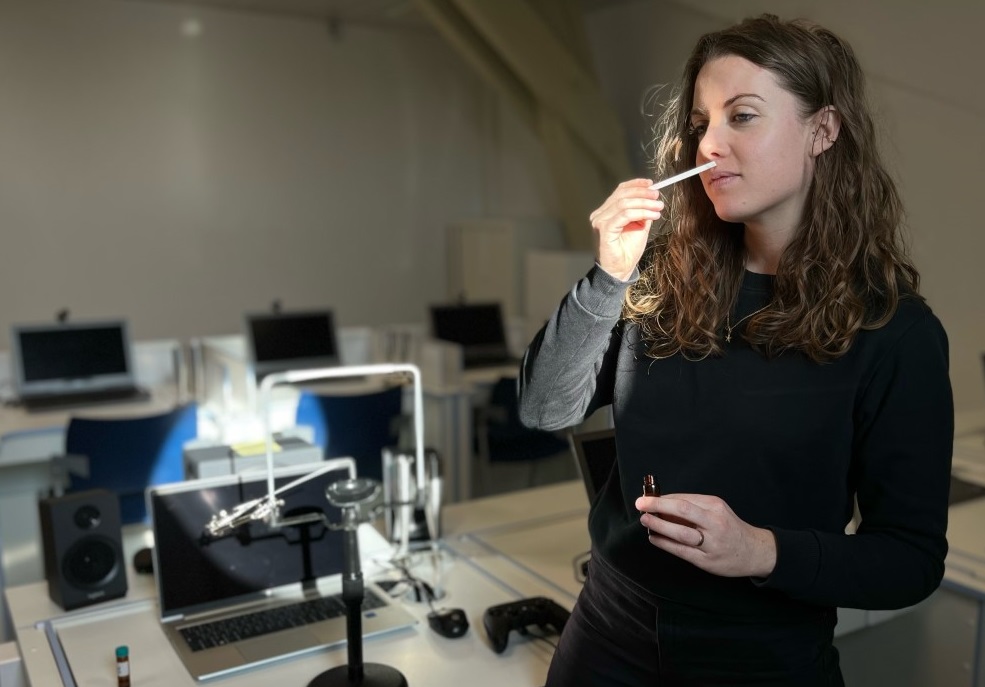
I study the influences of multisensory environments on human cognition. I explore the effects of personalized and imposed multisensory environments on cognitive performances/executive functions of young and older adults.
As Marianna Obrist and Carlos Velasco wrote about themselves in their book Multisensory Experiences, Where the Senses Meet Technology, I am fascinated by the power of the senses and the opportunities to shape impressions. A better understanding of how multisensory environments influence cognition should enable the development of concrete and relevant applications in health fields. It should be possible to adapt workplaces, schools, hospital living spaces, and senior residences for better cognitive performances and well-being of the users.
Research interests:
My research focuses on multisensory perceptions and their impact on human interaction with others and their environment.
Multisensory Perceptions, Music, and Objective and Subjective Performance:
My current research interests explore the effects of personalized and imposed multisensory environments on executive (i.e., working memory update, cognitive flexibility, and response inhibition) and perceived performance in young and older adults. Odors and music are distinct sensory stimuli that can be used to create specific atmospheres, but scientific literature on how people use sensory stimuli to shape daily experiences is scarce (Kiss & Linnell, 2023). I conducted two studies to understand how people of different ages use music and odors in daily life and for concentration. Then, I examined the perceived favorability of music and odors for focusing on a demanding cognitive task. A study was conducted to understand how affective characteristics (pleasantness, familiarity, and arousal) build the perceived favorability of a sensory stimulus for cognitive focus. I also aimed to determine if affective characteristics of different sensory stimuli could enhance the perceived favorability of a multisensory environment for cognitive tasks. Finally, an experiment was conducted to investigate the effects of personalized or imposed, favorable or unfavorable music and odors, delivered separately or together, on executive and perceived performance in young and older adults. Three papers are currently in preparation, and one is under review.
Perspectives. I aim to investigate how olfactory perception influences the pleasantness and congruence of multisensory experiences.
Anosmia, hyposmia and autobiographic memories:
My current research interest lies in how olfaction, a sense strongly linked to memory and emotions, impacts autobiographical, executive, and emotional memory skills (Challakere Ramaswamy & Schofield, 2022; Greco-Vuilloud et al., 2026). Notably, this relationship has been observed at both brain and behavioral levels. However, the link between olfactory, memory, executive, and emotional capacities through autobiographical memory, which is central to identity, goals, and motivation (Conway & Jobson, 2012), remains understudied. My goal is to study how olfactory function impacts overall cognitive functioning (memory and executive function) and emotion in anosmic and presbyopic patients.
Perspectives. In collaboration with Dr. Jane Plailly (CRNL, Université de Lyon) and Pr. Auriane Gros (CoBTeK laboratory, Université Côte d'Azur), we developed a research project addressing this topic. Stay tuned for updates!
Somatosensation, bodily perception, and self-recognition:
My research interest focuses on how the sense of embodiment arises from the congruence of multisensory information. I am passionate about bodily perceptions and the use of experimental illusions to study them. I conducted a study using the Rubber Hand Illusion, manipulating finger postures to create multisensory congruence and incongruence. The findings challenged internal body models and aligned with the theory of probabilistic multisensory integration. One paper on this topic was published in 2023 in Multisensory Research.
Perspectives. Understanding how somatosensory stimuli interact could aid clinical populations by developing therapies, treatments, and prosthetics.
Predictions, uncertainty in sensory experiences:
Anticipation and uncertainty shape the pleasantness and vividness of various sensory experiences. I've explored the neurocognition of musical thrills without conducting empirical studies. Research suggests that musical thrills arise partly from the anticipation of musical continuity and from the surprise of mispredicted notes (Cheung et al., 2019). I am interested in how the brain processes and matches sensory predictions with perceived stimuli, and why some sensory experiences are perceived as pleasant or unpleasant. I believe that understanding the role of predictions and uncertainty in uni- or multisensory experiences is crucial for clinical populations (e.g., amputees, stroke survivors).
Activités / CV
Bartoletti, R. L., Denis-Noël, A., Langenecker, S. A., Steiner, D., & Corveleyn, X. (2026). Alternative Forms of the Parametric Go/No-GO Task: Development and Comparison. Journal of Clinical and Experimental Neuropsychology. https://doi.org/10.1080/13803395.2026.2707993 (Q2 ; IF : 1,8).
Andrieu, C. F. A., Bartoletti, R. L., Milhabet, I., Denis-Noël, A., & Steiner, D. D. (2026). From Speaking Up to Shutting Down: The Cognitive Costs of Non-Instrumental Voice. Acta Psychologica, 262, 106163. https://doi.org/10.1016/j.actpsy.2025.106163 (Q1 ; IF : 2,7).
Bartoletti, R. L., Corveleyn, X. (2025). An Integrative Cognitive Model for Multisensory Design: Benefits and Risks of AI-Personalization. Frontiers in Computer Science - Human-Media Interaction. https://doi.org/10.3389/fcomp.2025.1652537 (Q2 , IF : 2,7).
Bartoletti, R. L., Denis-Noël, A., Boulvert, S., Lopez, M., Faure, S., & Corveleyn, X. (2023). Visuo-Tactile Congruence Leads to Stronger Illusion Than Visuo-Proprioceptive Congruence: a Quantitative and Qualitative Approach to Explore the Rubber Hand Illusion. Multisensory Research, 36(6), 477-525. https://doi.org/10.1163/22134808-bja10101 (Q3 ; IF : 2,352)
Forestier, C., de Chanaleilles, M., Bartoletti, R. L., Cheval, B., Chalabaev, A., & Deschamps, T. (2023). Are trait self-control and self-control resources mediators of relations between executive functions and health behaviors? Psychology of Sport & Exercise. https://doi.org/10.1016/j.psychsport.2023.102410 (Q1 ; IF : 5,118)
Keywords:
multisensory environments; cognitive performances; personalization; music; odors; aging