MemBioMed TRACK : From Membrane Biology to Neuroscience and Experimental Medicine (Erasmus Mundus Joint Master)
- Science and Technology
Résumé
MemBioMed is a a programme designed to prepare a future generation of scientists, entrepreneurs and senior executives for a leading role in studying the complex behavior of cellular membranes and exploiting their full therapeutic potential. Read moreObjectifs
Details
Consortium
Université Côté d'Azur (UniCA, France)
Università di Genova (UniGE, Italie)
Universität Osnabrück (UOS, Allemagne)
Erasmus Mundus Joint Master
Fully in english
Accéder aux sections de la fiche
Introduction
The International MemBioMed Master’s Programme (From Membrane Biology to Neuroscience and Experimental Medicine) is a high-quality, fully integrated degree emphasizing multidisciplinary research on biomembranes.
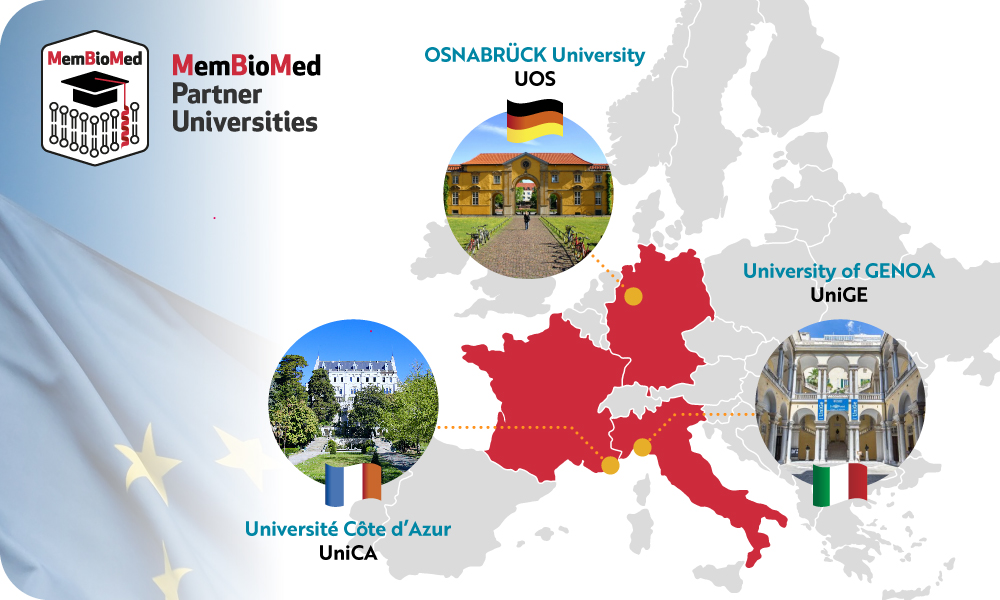
This program is a collaboration between three prestigious universities: Université Côte d'Azur (UniCA, France), University of Genoa (UniGE, Italy), and University of Osnabrück (UOS, Germany) :
- Université Côte d'Azur (UniCA, France)
- University of Genova (UniGe, Italy)
- Osnabrück University (UOS, Germany)
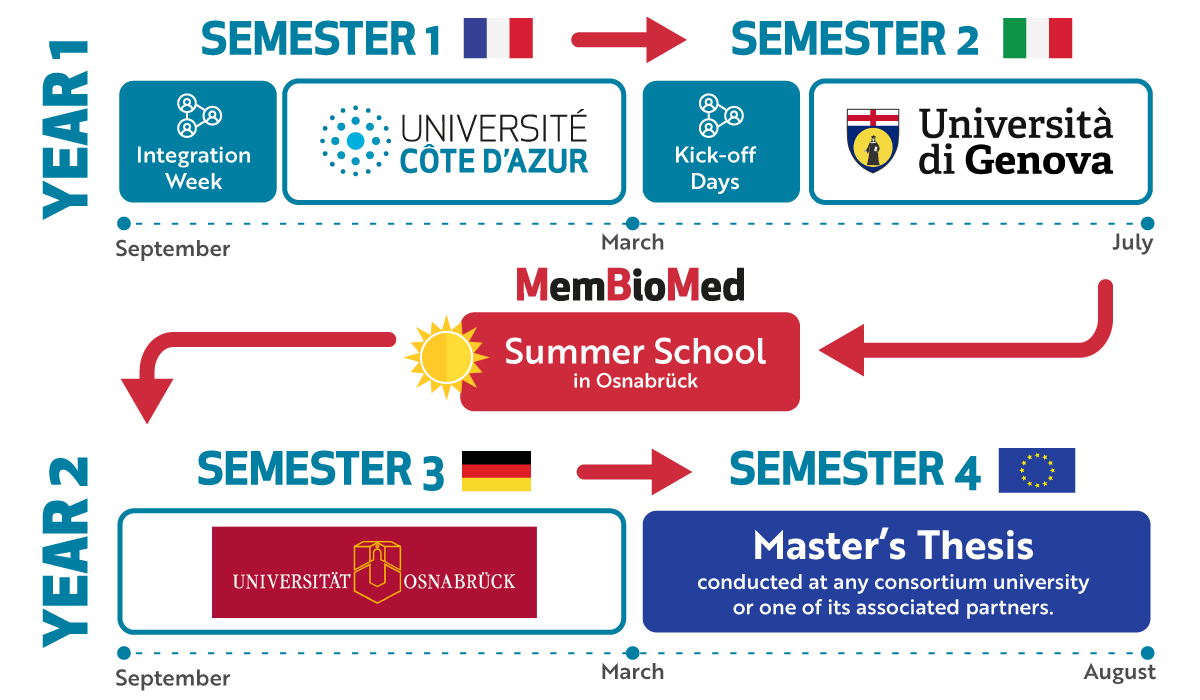
Students will follow a unique learning path:
Semester 1 : Université Côte d'Azur, France
Semester 2 : University of Genova, Italy
Semester 3 : Osnabrück University, Germany
Semester 4 : Master’s Thesis conducted at any consortium university or one of its associated partners, subject to prior approval of the Master's Thesis project by the MemBioMed Board.
The curriculum integrates the latest scientific advancements in biomembranes, offering students engaging research opportunities through collaborative projects and partnerships with industry. It includes hands-on internships to develop practical expertise and interdisciplinary skills, as well as workshops and thematic schools addressing emerging technologies and key challenges in the field.
This well-rounded training equips graduates to become leaders in science, entrepreneurship, and industry, specializing in the intricate dynamics of cell membranes and their therapeutic applications. The program also emphasizes effective communication and networking, preparing students to excel in global leadership roles.
- Course KPIs
-
Professionnal Integration rate¹ Data not available for this programme Completion rate² Data not available for this programme Satisfaction rate³ Data not available for this programme ¹Master Life Science 2022 data, 6-month survey - Source: OVE IP
²Master Life Science 2022 data, Source: Scolarité Valrose
³Master Life Science 2022 data, even semester - Source: MEAV
Specificities
Joining our Master’s program means choosing a demanding curriculum, but it also means becoming part of a dynamic and supportive class!
The NiCells Student Union (BDE) is a student association dedicated to supporting students in the EUR LIFE Master’s programs in Life Sciences and Neuroscience throughout their academic journey by fostering mutual support, guidance, cohesion, and class spirit, with the aim of making the university experience as enriching on a personal level as it is academically.
Learn more about the NiCells Student Union (BDE) and its initiatives
Places
- Nice, France
- Osnabrück, Germany
- Genova, Italy
Person in charge of the academic program
- Delphine BICHET (Programme coordinator)
- Romain GAUTIER (UniCA coordinator)
- Joost HOLTHUIS (UOS coordinator)
- Anna FASSIO (UniGE coordinator)
- Clémence BENOIT (Coordination officer)
The MemBioMed programme team is composed of researchers, teachers, lecturers, and professors from the three participating higher education institutions, all of whom share a common interest in biomembranes. They serve on various governing bodies.
The MCO is responsible for managing the internal operations of the program. It consists of a programme coordinator, an officer coordinator, and a local academic coordinator at the coordinating university, UniCA. The two partner universities, UniGE and UOS, each have a local academic coordinator who oversees the organisation of the programme at their respective institutions. The MCO is supported by two local academics from each university, forming sub-committees to assist the local coordinators in carrying out their responsibilities.
Partnership
Institutions
The MemBioMed consortium partners are:
- Université Côte d’Azur (UniCA, France), coordinator and beneficiary
- University of Genoa (UniGe, Italy), full partner
- Osnabrück University (UOS, Germany), full partner
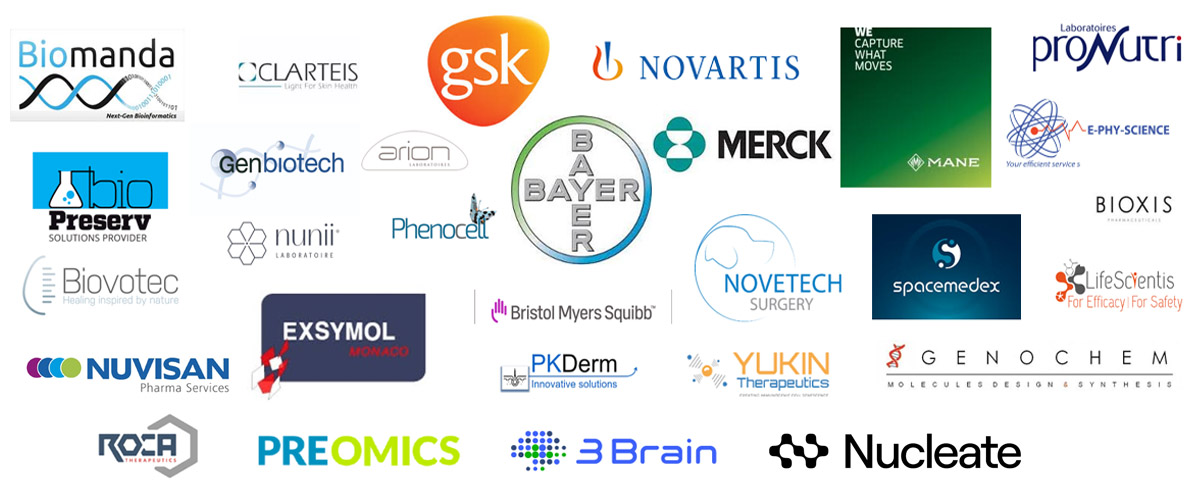
The three full partners have outstanding academic reputations, underpinned by research and publications, student success, available resources and close links with industry.
Université Côte d'Azur (UniCA, France)
The University Côte d’Azur (UniCA) is one of the only places in France where renowned specialists in membrane protein and lipid research work side by side in national research center (from CNRS and INSERM). As these specialists participate in multiple national and international collaboration networks (IDEX Jedi, LABEX ICST/SIGNALIFE, and ERC SPHERES), their competence and expertise, cover virtually all facets of molecular and cellular membrane biology.
University of Genoa (UniGE, Italy)
The University of Genoa (UniGe) harbors the Center for Synaptic Neuroscience and Technology (NYSNC), a site of excellence for neurology and clinical neuroscience. The Center is widely known for its multidisciplinary research and education programme on brain function and diseases. Its scientists are at the forefront of developing novel technologies to modulate biomembrane-related neurological functions.
Osnabrück University (UOS, Germany)
Osnabrück University (UOS) and its Center for Cellular Nanoanalytics (CellNanOs) offer interdisciplinary and research-oriented training at the interface of biology, chemistry and physics with a major focus on the development of novel biophysical techniques to resolve and quantify dynamic processes at cellular membranes, from mesoscopic down to atomic scales. Its scientists participate in collaborative research and training networks to unravel the functional plasticity encoded in cellular membranes (SFB1557, RTG2900).
Corporations
In agreement with
- At UniCA, academic teams are part of the University Hospital Federation FHU INOVPAIN.
- UniGe and the associated IIT have research agreements with the IRCCS, Ospedale Policlinico San Martino, and Genoa in the fields of molecular and cellular neuroscience and oncology.
Admission
Prerequisite
Prerequisites for enrolment
Prerequisites training
English Language Proficiency Requirements
The whole MemBioMed programme is taught in English and English proficiency is therefore a basic requirement. All applicants must provide recent proof (maximum 2 years old) of their proficiency in English through at least one of the following certificates:
- TOEFL iBT Certificate: minimum overall score : test taken before Jan 21, 2026 : 90 - test taken after Jan 26, 2026 : 4,5 - Other TOEFL versions are not accepted
- IELTS Certificate: minimum overall score of 6.5
- Cambridge English Certificate : minimum overall score of 176
Duolingo is not accepted
Test reservation is not accepted, only official result is accepted
Certificates issued for English-taught courses or study programs (MOI) will not not be accepted
You do not need to prove your English language ability if:
-You are a national of one of the countries listed below, or
-You have completed your Bachelor degree in one of these countries
Australia, Canada, Ireland, New Zealand, UK and USA
Candidated from countries not listed above, must provide an English language certificate. No exceptions or exemptions will be granted.
Please note than oral English proficiency will also be taken into account during interviews of applicants in phase 3.
Educational Background
All candidates should possess a Bachelor of Science degree in Biology or equivalent diploma in Life Sciences with advanced courses in cell biology, biochemistry, genetics, molecular biology, biophysics. Degree equivalent to at least 180 ECTS.Applicants with well documented lab experience in the Molecular Life Sciences will be prioritised.
Below backgrounds are non eligible :
Marine biology, Environmental sciences, Nursing, Agricultural biology, Nutritional sciences, Dentistry, Veterinary, Surgery, Physiotherapy, Radiology and Zoology.
A Candidate who is currently enrolled in the last year of Bachelor at the time of application is allowed to apply, but final admission will only be effective if proof of graduation is provided before MemBioMed programme start, i.e. in July of the application year for the latest.
Target audience
- Students from all around the world
- Students willing to study abroad
Visit the "Mission Handicap" website
Application
Conditions of applications
MemBioMed application and registration process
Conditions of admission / Conditions of successful application
1. Eligibilty Check
Eligibility check will be performed by the application platforms during and immediately after the closure of the Call for applications. At this stage, the fulfilment of the minimum requirements specified above will be verified.
2. Preselection
The selection process has been meticulously designed to ensure fairness and inclusivity, taking into account diverse backgrounds and experiences. Each eligible application will undergo a thorough evaluation, scored on a 100-point scale by three Local Academic Coordinators from distinct Full Partner Institutions. To maintain objectivity, any evaluator must disclose potential conflicts of interest before the assessment.
The joint selection criteria are as follows:
- Academic achievement and potential (Grades and ranking, relevance of the academic background; 40 points). Cut off set at 25 to continue the preselection process.
- Overall quality of the CV (practical skills, other relevant experiences; 30 points)
- The quality of the cover letter (clarity/motivation, adequacy with the programme ; 20 points)
- Recommendation letters (quality /academic, relevance ; 10 points)
The SEC shall review the final grading and comments, compile a ranking based on average scores.
The cut-off to qualify for the interview is set at 75.
Candidates reaching this score will be contacted by email and invited to the 3rd phase (interview)
Remaining candidates will be notified about the panel’s decision and alerted to the appeal procedure via email.
3. Interviews
Interviews will be conducted via video conferencing by at least three evaluators, each interview will last max 20 minutes, including a maximum 5-minute presentation.
During the interviews, candidates will be assessed on common criteria:
- Communication skills and language proficiency (30%)
- Motivation and alignment (30%)
- Academic and professional background (25%)
- Personality and interpersonal skills (15%)
- scholarship awardees
- successful applicants without scholarships
- waiting list
Program
Content of the academic programm
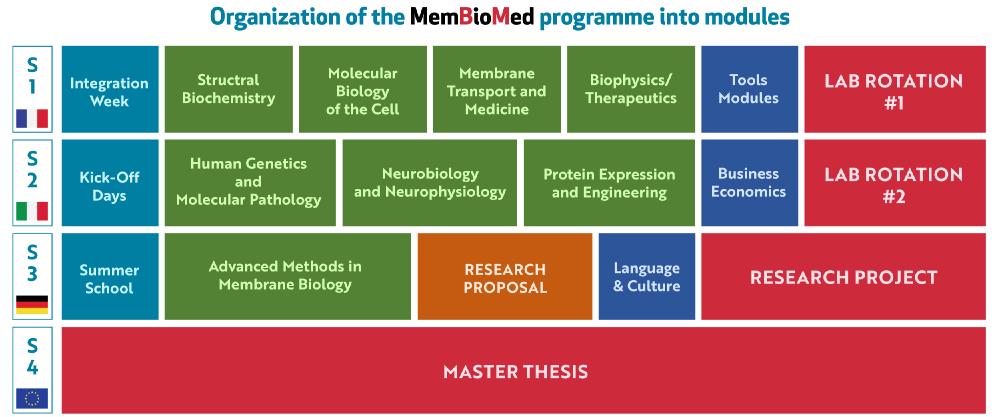
The academic programme is based on three existing, successful national master programmes in UniCA (France), UniGe (Italy) and UOS (Germany). In each of these master's programmes, we find the main aspects of membrane biology, but none covers all aspects of membrane biology to train the most highly qualified international specialists in the field of biomembranes. Building on our synergistic strengths, we have defined a common core of knowledge and strengthened these skills by refining the content of the programme to reflect current trends and advances in industry.
2. Practical modules (in orange)
3. Complementary modules (in blue) and international events (in yellow)
We have defined that students should acquire a thorough understanding of the structure, function and physicochemical properties associated with biological membranes and knowledge of some fundamental differences between organisms, between tissues and between intracellular organelles in terms of membrane composition and properties. Students should gain an in-depth understanding of membrane-dependent cellular processes, such as cell signaling and membrane transport, under physiological and pathological conditions. Such a programme should also focus on the integration of messages by cells via cell membranes and the regulation of the cellular responses; this knowledge being fundamental for the development of new therapies.
In addition, students are expected to master advanced analytical techniques, including electrophysiology, spectroscopy and microscopy, for in-depth study of biological membranes. Students are also expected to apply their knowledge to problem-solving scenarios by carrying out independent research projects.
Finally, the integration of soft skills and economic and intercultural competencies will help to train professionals ready to succeed in more competitive and diversified environments.
Semester 1
The first semester in UniCA will provide the students with the foundation on structure and function of biological membranes. The courses will focus on the physicochemical properties of biomembranes and on understanding the molecular and cellular properties of the constituents of cell membranes, mainly lipids and proteins.
Semester 2
The second semester in UniGe will provide the students with a comprehensive understanding of biomembranes-related pathologies and neurological functions. The courses will focus on the genetics and the molecular bases of disease, as well as the function and dysfunction and on therapeutics strategies used to modulate neuronal activity.
Semester 3
The third semester in Osnabrück will focus on preparing the students for their master theses by providing methodological specialization in the field of cellular nanoanalytics. The courses will focus on advanced techniques to investigate biological functions at cellular membranes with highest spatial and temporal resolution.
Semester 4 : Master's thesis
The Master's thesis can be prepared in any of the full partner’s institutions or associated partners. Projects from academia and industry are presented to students during the summer school between semesters 2 and 3, promoting direct interaction of students with supervisors. In addition to classical Master projects, supervised by a single supervisor, we also want to offer Masters projects with dual supervision by researchers from two laboratories.Internship(s)
- One lab training in semester 1
- One lab training in semester 2
- One research project in semester 3
Periods spent abroad
Students will follow a unique learning path:
- Semester 1: Université Côte d’Azur, France
- Semester 2: University of Genova, Italy
- Semester 3: Osnabrück University, Germany
- Semester 4 : Master’s Thesis conducted at any consortium university or one of its associated partners, subject to prior approval of the Master's Thesis project by the MemBioMed Board.
Mentored project(s)
The Master's thesis should demonstrate that the candidate is able to work independently within a defined time period on a specific question within the field of biomembranes using appropriate academic methods, and to present this work accordingly. The topic of the Master's Thesis and the nature of the assignment must comply with the objectives of the programme and the allocated working period. The thesis is written in English.
Conditions
Assessment
- Transfer of credits
-
All modules are designed in accordance with the ECTS System (European Credit Transfer and Accumulation System) and national regulations. HEIs partners accept differences in national and/or local regulations among the Partner Institutions concerning awarding ECTS credits and they recognize the number of ECTS credits awarded by other HEIs in the Degree Programme without further conversion. All grades shall be converted and recognized in conformity with a conversion table for grades. The credit transfer process involves the sending of student marks by the partner universities attended per semester to the MemBioMed Coordination Office (MCO). The MCO handles administrative procedures for ECTS recognition among participating HEIs, allowing the local Master diploma to be awarded. After obtaining all required credits and successfully defending the Master Thesis, official diplomas and diploma supplements are issued by the relevant HEIs and the MCO. Each Full Partner issues transcripts of records covering the semester completed at its university, sending them to the next institution and the Coordinator Officer for database recording. All grades shall be converted and recognized in conformity with a Conversion Table for the Consortium.
- Examination regulations
-
Students must comply with the examination regulations and criteria of the HEI where they attend the teaching modules. HEIs partners are responsible for organizing and conducting examinations and assessments in accordance with the policies and procedures in place at the HEIs. At the end of each academic year, the Selection and Examination Committee (SEC) will review the study performance status of each student and will advise on continuation of the programme in accordance with the regulations at each university. Students should have validated 60 ECTS credit points in the first year to be accepted in the second year. Students with very weak study performance may lose their scholarship or may be advised to end their study. Students who quit the programme early but have successfully completed courses will get a certificate stating the courses for which they have earned credits.Students who do not complete the study programme by the end of the timeframe defined in the student agreement (two years), may, upon approval of the MMB, still enrol for a third year. In case a student does not complete the programme after an additional third year, this student will no longer be allowed to participate in the programme. In this case, the student will receive an official transcript listing the courses for which he/she has obtained credits.
The examination regulations of each higher education establishment can be consulted by clicking on the links below:- Université Côte d'Azur : UniCA examination regulations
- Osnabrück : UOS examination regulations
- University of Genoa : UNIGE UOS examination regulations
- Internship and research project evaluation
-
The internship shall be supervised by scientists specialised in Biomembranes employed at the organisation where the internship takes place. The duration of each internship should be at least 6 weeks. After having completed the internship, students will write a short report or present their internship experience, work tasks, and learning outcomes. The internship supervisor shall fill in a brief form about the intern´s performance and contribution. These documents will be evaluated by the local coordinating team as part of the Quality Assurance. Associated partners, guest lecturers or invited scholars may participate in these seminars as experts in the field who provide additional advice and guidance.
- Master Thesis defence
- The Master's thesis project will require approval by the MemBioMed Coordination Office (MCO), based on its scientific quality, ethical considerations, and alignment with the objectives and expected learning outcomes of the MemBioMed programme. The partner institution hosting the student during the fourth semeter will be responsible for evaluating the Master's thesis according to its local examination regulations. The thesis should demonstrate the student's ability to independently conduct a scientific research project within the field of biomembranes, using appropriate academic methods and presenting the results in a clear and rigorous manner. The Master's thesis must be written in English.
- Resit
-
A number of instructions have been established for the conditions of retaking process for the final master examination, including the conditions for rescheduling, provisional validation of corresponding mobility, and final validation upon successfully passing the exam, as well as the exception for students in the last intake of the programme. These instructions are as follow:
- Eligibility for retaking the final master examination is limited to students who have failed the initial attempt.
- The rescheduled examination will take place between 3 and 12 months following the initial unsuccessful attempt.
- Provisional validation of the corresponding mobility may be granted in the case of a failure on one exam.
- Final validation is conditional upon successfully passing the exam in the following year, which may require the student to re-enrol in the programme at the university offering the course and retake the entire programme.
- This retaking procedure does not apply to students enrolled in the last intake of the programme.
- Students who meet the eligibility criteria for retaking the final master examination should contact the appropriate university department to initiate the rescheduling process.
- Students should also be aware of any additional requirements or fees associated with retaking the exam.
- It is recommended that students prepare thoroughly and seek academic support if needed prior to retaking the final master examination.
What's next ?
Level of education obtained after completion
Degree equivalent to 4 or 5 years' higher education (Bac +4 & Bac +5)Target skills
RNCP URL of content
Target activities / attested skills
This will be achieved by realizing the following objectives:
- to provide students with combined theoretical knowledge in biomembrane-related cell biology, structural biology, pharmacology, neurophysiology, biophysics, biochemistry and bioinformatics;
- to recruit the best students from all over the world, providing them with physical mobilities and access to the world-class scientists in the field of biomembranes;
- to promote, structure and sustain collaborations among the partner universities through the organisation of joint training events and the exchange of students and staff;
- to promote innovative biomembrane research at the interface of different disciplines;
- to train students with state-of-the-art knowledge for studying cellular membranes across multiple scales and disciplines, from monitoring the complex interactions among protein and lipid components at highest resolution to how their collective properties influence biological processes at the level of cells, tissues and organisms in health and disease;
- to produce well-rounded student profiles with practical work and project-oriented formation for the development of innovative downstream applications;
- to increase the employability of students in the pharmaceutical and biotechnology industries by providing them with hard and soft skills associated with entrepreneurship and industrial networks;
- to provide a valuable specialized workforce in line with unmet academic and industrial demands in clinical pharmacology, experimental medicine, neuroscience and nanotechnology;
- to improve the quality of the European Higher Education Area by intensifying academic cooperation and internationalisation among MemBioMed’s participating HEI’s.
Further studies
Job opening
Business sector or job
Employability
The impact of the programme is determinant for students, as it offers multidisciplinary training in the rapidly evolving field of biopharmacology, and provides them with a set of skills that enhance their employability and competitiveness in the job market. Graduates will have a wide range of career opportunities. If they continue their training with a PhD thesis, they will be qualified for positions as biology researchers in academic or industrial research to study biological or neurological processes, develop new therapies or medicines, or explore new biotechnologies.If they complete their studies after the Masters, they could work as (non-exhaustive list):
- lab technician or engineer, designing, developing and improving products or understanding processes in the pharmaceutical or medical fields, often in academic, medical or industrial research environments
- scientific or medical advisers
- biotechnology consultants
- pharmaceutical product
- medical device developers
- teachers or trainers in the life sciences or scientific communicators
Skills
The MemBioMed programme's emphasis on training through research acts as a catalyst to transform students into active learners. By encouraging them to study a chosen field in greater depth, it enables students to become key players in the field of biomembranes. In this way, the academic programme transmits not only theoretical knowledge, but also practical knowledge in the laboratory and so-called 'complementary' skills. These skills are provided by both soft skills (scientific writing, dissemination of science and communication) and hard skills (animal experimentation, biological image processing, imaging of living organisms, organoids, bioinformatics, biological imaging techniques for research and medicine, scientific communication, health and safety, quality assurance, etc.), as well as project-based learning, introductory business and economics courses, language and culture courses, workshops and cultural activities. These complementary skills help to forge a mind-set of continuous learning, communication, adaptability and innovation, preparing students to become leaders in a rapidly evolving field of biomedicine. Another advantage of the MemBioMed programme is the development of international networks between the programme's students (current and former), teachers and professionals. These networks extend beyond the academic world and can lead to collaboration on various projects, cultural initiatives and even businesses. The diversity of backgrounds and experiences of programme participants enriches these networks, encouraging innovation and intercultural dialogue.
After Studies
Respond to societal and labour market needs and contribute to a global workforce: We designed the MemBioMed programme primarily to train students to succeed in the job market in the pharmaceutical and biotechnology industries. The interdisciplinary theoretical programme provides students with combined theoretical knowledge of cell biology, structural biology, pharmacology, neurophysiology, biophysics, biochemistry and bioinformatics in disciplines related to biomembranes, in line with academic and industrial demands in clinical pharmacology, experimental medicine, neuroscience and nanotechnology. Extensive practical experience and project-based training, often at the interface of different disciplines, create well-balanced student profiles. Intercultural skills, compulsory mobility in three countries and multilingual skills (English, French, German and Italian) help to produce not only skilled professionals conducting innovative biomembrane research, but also individuals who share a common sense of European values and a truly global mindsetDoctoral Schools
Considering applying to doctoral studies ?Upon completion of the M2, graduates from the MemBioMed Master may pursue a PhD in laboratories within the region primarily, but also elsewhere in France, in Italy, in Germany or abroad.
- Université Côte d'Azur: https://univ-cotedazur.eu/doctorate-phd
Professional integration
Submission
Tuition
- Fees are waived for Erasmus+ EMJM scholarship-holders from all countries.
- Applicants admitted to the programme but not awarded an EMJM scholarship grant may be accepted to the programme as self-financed students on the condition that they pay the full tuitions fees and living costs by their own for the entire duration of the programme.
Tuition fees will be paid to Université Côte d'Azur and will also cover student insurance and joint education activities.
- European Students: 510€* /full programme
- Non-European Students: 7900€* / full programme
Costs Included
Participation in the MemBioMed program will cover :
- Registration as a regular student at each host university
- Participation in all teaching activities
- Participation in the seminars and workshops organized by the consortium
- Access to all the student services and activities (library…)
- Student support in administrative and migratory procedures
- Health, liability, accident, and assistance insurance (Membiomed Insurance paid for by the program for all students). For more information, contact the project coordinator.
Costs non-included
- All students have to enrol for the Student and Campus Life Contribution (CVEC) when studying at a French University (~105€ per year).
- MemBioMed scholarship holders do not have to pay the CVEC.
- Self-financed MemBioMed students have to pay the CVEC by themselves as it is mandatory by French law (plateforme opening in May).
- Please note that tuition fees do not cover the following:
- living expenses
- transportation costs (such as travel and visa fees)
- meals
- copies and books.
- Students are also liable for the payment of any fees related to national regulations.