PARCOURS - Master track in Astrophysics (MAUCA)

  • Science and Technology
PARCOURS - Master track in Astrophysics (MAUCA)

Call to actions

In the aim that we contact you back

This field is optionnal. If you do not fill it, the sample above question will be send.

enter the word in the caption

Sending the message...

Message sent.

An unexpected error occured during the processing of your request. Could you please try reaching us by phone ?

Résumé

MAUCA is a high-level, two-year international master’s program in astrophysics, based on immersive learning in research laboratories and through modules called METEORs, in close collaboration with leading experts. Read more

Objectifs

Initial training / Accessible for resumption of studies /
Unknown label
2 years
Portail Sciences et Technologies / École Universitaire de Recherche Sciences Fondamentales et Ingénierie
Nice Campus Valrose / Plateau de Caussols Calern
English

Details

Program highlights

  • Affiliated with three Côte d'Azur laboratories of excellence - Lagrange, Géoazur, and Artemis - for immediate immersion in cutting-edge research.
  • 100% English-language program, with an international outreach.
  • Customizable program: select up to 70% of your courses according to your academic and professional interests.
  • Unique hands-on experience: two weeks of immersion at the Calern Observatory, working with the twin 1-meter telescopes (C2PU).
  • Prepare for a career in either fundamental astrophysics or the space industry, depending on your goals.
  • Internships in Europe: MAUCA offers funded, two-month internships at a dozen European partner universities.

Career opportunities

  • Opportunities in higher education and research:

- Teacher-researcher
- Researcher at CNRS or INRIA
- R&D engineer

  • Opportunities in the private sector:

- Engineer, R&D engineer, data scientist
2/3 of MAUCA program graduates pursue a doctoral degree.

Apply now!

Are you interested in contributing to scientific research and becoming an astrophysicist?

Join the MAUCA program, starting at the first-year master’s level, by submitting your application on the Mon Master platform

  • Closed → Additional application period

Applying directly at the second-year master’s level?
If you are not a Université Côte d’Azur student or wish to change your program, submit your application on the Université Côte d’Azur eCandidat platform

  • Closed → External applications open for second-year students

Introduction

The Master's Track in Astrophysics (MAUCA) is one of the four tracks offered as part of the Master's program in Fundamental Physics & Applications.

The program focuses on the key themes in astrophysics for the 2020s and beyond. In the MAUCA program, you will learn:

  • To understand the characteristics of current and future theories.
  • To use the tools of modern astrophysics and space science.
  • To interact, share ideas, and present your results.
  • To work as part of a team on cutting-edge research and/or industrial projects.
The Master's Track in Astrophysics (MAUCA) offers a project-based and collaborative learning experience in close collaboration with leading experts through immersive modules called Experiment-Theory-Research Modules (METEORs).
 
An international program

30 to 50% of students come from more than 12 different countries (Brazil, the United Kingdom, India, Iran, the United States, Yemen, etc.)

 
Success rate

91%* (of 11 second-year students)

*Data provided by the Academic Services Department of Université Côte d'Azur (2025)

Employment rate

1 year after graduation:
- Approximately 65% are pursuing a doctoral degree
- Nearly 20% are applying for a doctoral program
- Less than 10% are working as engineers

3 years after graduation:
- More than 70% have completed or are pursuing a doctoral degree
- ~25% have become engineers 

*Source: https://mauca.oca.eu/fr/after-mauca 


The Master's Track in Astrophysics (MAUCA) is a program of excellence that covers all aspects of astrophysics, from theory to research techniques. To achieve this goal, the program emphasizes experiential learning: 70% of the courses are taught through immersion in research laboratories selected by the students themselves.

Within this framework, the MAUCA program focuses on three fundamental goals:

  1. Understand the physical mechanisms of the universe.
  2.  Master current theories across the many fields of astrophysics.
  3.  Acquire the skills required for research.
 

To find out the student satisfaction rate, contact the head of the program

The key strengths of the program:

Personalized courses with METEORs: select 70% of your Experiment-Theory-Research Modules (METEORs) from a wide range of topics such as planetary sciences, stellar physics, cosmology, instrumentation, signal processing, numerical methods, and the space industry.

Hands-on experience: Spend two weeks at a professional observatory dedicated to the twin 1-meter telescopes of the Centre Pédagogique Planète Univers (C2PU) project at the Calern Observatory. Engage in a practical and rewarding experience planning your observations, using the telescopes, and analyzing the data.

International program: taught entirely in English and immersion in an international environment. One out of every six Experiment-Theory-Research Modules (METEOR) is taught abroad, offering a unique learning experience at one of our partner universities across Europe.

Personal laptop: Each MAUCA student receives a personal laptop prepared by the Côte d'Azur Observatory for the two years of study, providing easy access to a wide range of online digital resources.

A dynamic and diverse student community: students from more than 12 different countries create a learning environment rich in cultural diversity.


Close interaction with faculty: personalized supervision and work in small groups of 2 to 3 students both during telescope training at the Centre Pédagogique Planète Univers (C2PU) and throughout each Experiment-Theory-Research Module (METEOR).
 

Post-graduation opportunities: most MAUCA graduates pursue doctoral studies in France and accross Europe, while others find opportunities in the space industry and computer science. Click here to view our post-graduation statistics >
 

Note: There is no option to recognize individual modules in this program.

Commitment to inclusion: Université Côte d’Azur has a disability officer on every campus to support students with disabilities.

On the Valrose campus:


Find out more about the support services and partnerships Université Côte d’Azur offers students with disabilities.
 

Formation accessible aux personnes en situation de handicap.
Consultez le site Mission Handicap

Formation éligible à MON COMPTE FORMATION
moncompteformation.gouv.fr

Courses for the master's program in astrophysics (MAUCA) are held at several locations, including:


  • Head of the program: Aurelien Crida
  • Head of the first-year master’s program: Benoit Carry
  • Head of the second-year master’s program: Georges Kordopatis
 

For all inquiries, please contact the following email address: mauca-contact@oca.eu

Partnership

The Master's Track in Astrophysics (MAUCA) at the SPECTRUM Graduate School, specializing in Fundamental Sciences and Engineering, is a research-intensive program affiliated with three laboratories on the French Côte d’Azur:

  • Lagrange logo The Lagrange Laboratory is a Joint Research Unit of the Côte d’Azur Observatory, CNRS, and Université Côte d'Azur. This multidisciplinary laboratory brings together research teams in astrophysics (planetary science, stellar and solar physics, galaxies, and cosmology), fluid mechanics, signal and image processing, and instrumentation for astronomical observations with high spatial and temporal resolution. Equipped with high-performance computing capabilities, the laboratory develops new theories and models, which are then tested against observations from large ground-based and space-based telescopes.

  • Géoazur logo The Géoazur Laboratory is a multidisciplinary unit bringing together geophysicists, geologists, and astronomers to address major scientific challenges such as geohazards and associated risks, lithosphere dynamics, Earth imaging, and geodesy and metrology of the Earth and the nearby universe. Géoazur has more than 100 permanent members affiliated with four institutions, two of which are local: Université Côte d'Azur and the Côte d'Azur Observatory, as well as two national research institutes: National Center for Scientific Research (CNRS) and Research Institute for Development (IRD) (four staff members are also affiliated with UPMC).

  • Laboratory of Laser Metrology for Fundamental Physics and Astrophysics (ARTEMIS) The ARTEMIS laboratory, affiliated with Université Côte d'Azur, CNRS, and the Côte d’Azur Observatory (OCA) is a major player in the field of gravitational waves. It is known for its expertise in stochastic signal detection, relativity, laser stability, and optical modeling. Artemis is working on current and future gravitational wave detectors used in the LISA and ET space missions, and on other research projects investigating the quantum limit, space debris, and gamma-ray bursts. The laboratory is also developing high-power lasers and cavities, and new precision metrology techniques.

The Master's Track in Astrophysics (MAUCA) has established long-standing collaborations with numerous observatories, universities, and European institutes where MAUCA students complete two-month METEORs abroad and a final three-month research internship:

A number of companies working in the space and high-tech industry are also closely associated with the Master's Track in Astrophysics (MAUCA) including:

Admission

Prerequisite

Graduate level

Prerequisites for first-year admission (M1)

  • Master the basic concepts and tools of physics.
  • Master mathematical tools for physics.
  • Master digital tools for physics (algorithms, programming).
  • Be motivated to conduct research.

Prerequisites for second-year admission (M2)

Students with a bachelor of science degree (L3 in France) in physics, mathematics, or engineering are eligible to apply.

Conditions of applications

For French or European applicants*


Click here to apply for the first (Master 1) or second year (Master 2)
 

Master 1

For first-year applications: submit your application on the national Mon Master platform.

Find the complete schedule on MonMaster >

Master 2

For second-year applications: If you are not a Université Côte d’Azur student and wish to apply for the second year, or if you are a first-year student and wish to change your program, submit your application on the Université Côte d’Azur eCandidat platform.

If you are a first-year master’s student at Université Côte d’Azur and are continuing in the same program in the second year, no application is necessary.
 

First-year master’s: Required documents

Selection is based on the application file, including the following documents submitted on the Mon Master platform:

- CV.
- Cover letter (in English).
- Certificate of English language proficiency.
- Post-high school transcripts.
- Proof of internships, if applicable.

If your application is accepted, your enrollment must then be confirmed by student services

Second-year master’s: Required documents

Selection is based on the application file, including the following documents submitted on the eCandidat platform:
- CV.
- Cover letter (in English).
- Certificate of English language proficiency.
- Post-high school transcripts.
- Proof of internships, if applicable.

If your application is accepted, your enrollment must then be confirmed by student services.


*Countries concerned
European applicants include nationals of countries in the European Union, the European Economic Area (EU + Norway, Iceland, Liechtenstein), Switzerland, Monaco, and Andorra.

Conditions of specific applications

For non-European candidates

  • If you reside in one of the countries or regions listed below*, submit your application on the platform Etudes en France.
  • If you are a non-European candidate who does not reside in a country covered by the Etudes en France procedure, submit your application for the first year (Master 1) in "Fundamental Physics and Applications" via the Mon Master platform once the application phase opens.
 
  • Master 2 applications must be submitted via the eCandidat Université Côte d'Azur platform, then select  then the M2 track "MAUCA".

If your application is accepted, your enrollment must then be confirmed by student services - campus-valrose.scolarite@univ-cotedazur.fr
 

*Countries and regions concerned

Algeria, Argentina, Azerbaijan, Bahrain, Benin, Bolivia, Brazil, Burkina Faso, Burundi, Cambodia, Cameroon, Canada, Chad, Chile, China, Colombia, Comoros, Congo, Democratic Republic of the Congo, Djibouti, Dominican Republic, Ecuador, Egypt, Ethiopia, Gabon, Georgia, Ghana, Guinea, Haiti, India, Indonesia, Iran, Israel, Ivory Coast, Japan, Jordan, Kenya, Kuwait, Laos, Lebanon, Madagascar, Malaysia, Mali, Mauritania, Mauritius, Mexico, Morocco, Nepal, Niger, Nigeria, Peru, Qatar, Russia, Saudi Arabia, Senegal, Singapore, South Africa, South Korea, Taiwan, Thailand, Togo, Tunisia, Turkey, Ukraine, United Arab Emirates, United Kingdom, United States, and Vietnam.


Program

Students customize two-thirds of the program by selecting modules called METEORs (Modules Experiment – ThEOry – Research) that provide them with an immersive experience in research laboratories or industry.

  • Two series of fundamental courses lay the foundations in astrophysics, physics, mathematics, data processing, machine learning, astronomical instrumentation, and numerical simulation.
 
  • Five Experimentation - Theory - Research Modules (METEOR). Each METEOR module lasts approximately two months and gives students the opportunity to tackle real-world research or engineering challenges in astrophysics and space science. Each METEOR program includes coursework taught by a world-class expert and supervised, project-based laboratory research. METEOR assignments include project reports, research papers, functional algorithms, computer programs, and oral presentations.

Students choose 5 METEOR modules from a list of more than 30 topics.

During the second year, one METEOR module is held in a foreign institution chosen by the student from a list of European partner universities.


METEOR modules can be divided into six main themes:
  1. Planetary sciences
  2. Stellar and galactic physics
  3. Extragalactic astronomy, cosmology, relativity
  4. Signal and image processing
  5. Optics and astronomical instrumentation
  6. Space and Industry
  • One immersion module: students spend two weeks in a professional astronomical observatory where they learn to use two 1-meter-class telescopes (C2PU).
  • One science communication module: students learn how to write articles, create scientific posters, plan scientific outreach activities, and give presentations.

Intensive program in observational astrophysics:

Following the fundamental courses, the program includes in-depth courses in all aspects of observational astrophysics:

  • Two weeks of university lectures and practical sessions on astrophysical objects* and data analysis techniques* (images, spectra).
  • Two weeks at the Calern Observatory working by night with the twin 1-meter C2PU telescopes to observe and analyze data as part of mini-research projects (the list below). 
Astrophysical Objects Observation Techniques End-to-End Mini Research Project
Exoplanets, Planets, Asteroids,
Stars, Clusters,
Nebulae,
Galaxies.
Astrometry,
Photometry,
Spectroscopy,
Speckle interferometry.

Proposed observation schedule,
Preparation for observations,
Observations,
Data reduction,
Data analysis.
 

The Côte d’Azur Observatory (OCA) provides each student with a personal laptop, set up and supplied for the two years of the MAUCA program.
 

Head of the Master’s track in Astrophysics (MAUCA): Aurélien CRIDA

  • Head of the first-year master’s program: Benoit CARRY
  • Head of the second-year master’s program: Georges KORDOPATIS
  • Head of international relations: Philippe BENDJOYA

First year

There is no internship in the first year of the master's program, but the Experiment-Theory-Research Modules (METEORs) account for 40% of the coursework.
METEORs are not internships, but rather courses, directed study, lab sessions, and supervised projects that take place in the laboratories. Students therefore benefit from more intensive supervision than they would during traditional internships.

Second year

  • Mandatory internship during Semester 2 of the master’s second year.
  • Duration: 14 weeks, from March to June.
  • Location: in a research laboratory or at a company, in France or abroad.
  • Assessment: internship report followed by an oral defense.
  • Internship opportunities: available positions are listed here >

Second-year internship conditions: The internship is mandatory and counts for half of the final grade (30 ECTS credits). It must be completed in a public or private research laboratory.

Find resources relevant to you (internship opportunities, internship agreements, etc.) on this dedicated page >

Two months in one of the European partner universities (http://mauca.unice.fr/index.php/international-meteor/)

Full time

  • Total hours for the academic year: 643 hours in the first year and 170 hours in the second year.
  • Number of hours of lectures: 273 hours (239 hours in the first year + 34 hours in the second year).
  • Number of hours of laboratory work (TP) and directed study (TD): 305 hours (245 hours in the first year + 92 hours in the second year).
  • Tutorials: 67 hours (40 hours in the first year + 27 hours in the second year).

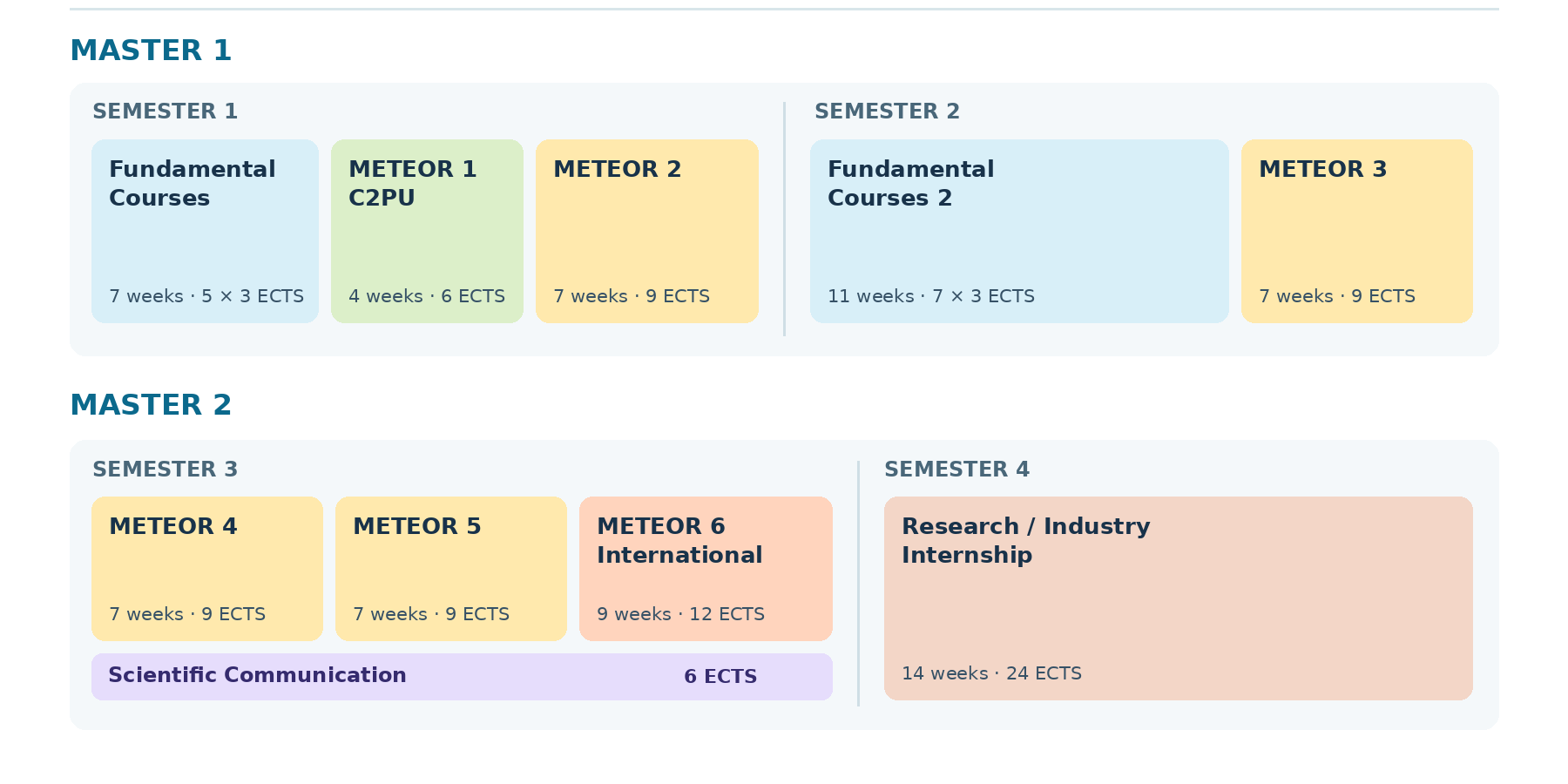
With the exception of the two series of fundamental courses in the first and second semesters, most of the MAUCA curriculum is based on immersive modules:

  • Observation training at the Centre Pédagogique Planète Univers (C2PU).
  • 4 Experiment-Theory-Research Modules (METEORs) in Nice.
  • 1 Experiment-Theory-Research Module (METEORs) abroad.
  • A 14-week internship during the second year of the master's program.
 

Semester schedule: First and second year

MAUCA Program
MAUCA Program

Validation criteria

  • Teaching unit (UE) credits earned: if the average grade is 10/20 or higher.
  • Semester passed: if the average of course grades is 10/20 or higher.
  • Academic year passed: if the average of the grades for both semesters is 10/20 or higher.
  • No failing grade.

Repeating the year: Students are allowed to repeat the year only in exceptional cases with the approval of the program's academic committee.

Transition from the first to the second year: At the end of the first year of the master’s program, the admissions committee decides whether to admit the student to the second year of the program and to a specific track.

Bonus (up to 0.25 points)
Students may earn bonuses for activities such as:
- Sports.
- Student volunteering.
- Innovation with the Demola organization.
- Minor courses: students in the master’s program in astrophysics can develop complementary skills beyond their major field of study in these courses. Each semester, students can choose a minor course from a wide range of elective courses to customize their program in line with their career goals and explore new opportunities. To learn more, click here >

Penalty:
Non-attendance.

View the assessment procedures for the MAUCA program>

What's next ?

Year of highschool graduation

Graduate level

Level of education obtained after completion

Degree equivalent to 4 or 5 years' higher education (Bac +4 & Bac +5), Graduate level

RNCP URL of content

The professional skills acquired in this program are listed in entry number 38994 of the National Directory of Professional Certifications.

  • Certifier: Université Côte d'Azur
  • Expiry date for RNCP entry: June 30, 2029

Target activities / attested skills

  • General astrophysics
  • Reading and speaking in English
  • Teamwork
  • Independent work
  • Bibliographic research
  • Scientific writing
  • Presentation of scientific results
  • Telescope observations
  • Data and signal analysis
  • Software development

Students may pursue their studies in a specialized master's program or a doctoral program, with the possibility of earning a CIFRE scholarship.

Since 2017, when the first MAUCA cohort graduated, two-thirds of MAUCA students have gone on to pursue doctoral studies.

More information on MAUCA statistics >

MAUCA graduates have been admitted to doctoral programs at various universities in France and across Europe.

Some have also found jobs in industry, particularly in the fields of aerospace engineering and computer science. More than 80% of MAUCA graduates were offered such opportunities before or within a few months of graduating.
 

The French Observatory of Student Life and Professional Integration (OVE-IP) conducts regular surveys on the transition to the workforce:

  • National survey of master’s and professional bachelor’s degree holders, 30 months after graduation.
  • Local surveys of master’s, professional bachelor’s and bachelor’s degree holders, 6 months or 1 year after graduation.

Find the Université Côte d’Azur employment rate from the Observatory of Student Life (OVE) >

Submission

Student and Campus Life Contribution (CVEC)

The CVEC is a mandatory contribution for all students pursuing their education in a public higher education institution, according to article L. 841-5 of the Education Code.

Before registering at the university, you must obtain a receipt of payment of the CVEC. This contribution must be made each academic year.

A receipt specifying your CVEC number is issued upon payment. This number is essential to proceed with your registration, either online or in person.

This contribution is mandatory for:

  • Students in initial education, as well as those in apprenticeship contracts, preparatory courses (CPGE), and in medical and paramedical programs (nurses, physiotherapists, speech therapists, etc.).
 
Exemptions

The following students may qualify for an exemption:
- Scholarship recipients.
- Students with refugee status.
- Students with subsidiary protection status.
- Students seeking asylum with the right to remain in the country, etc.

As a future scholarship recipient at Université Côte d’Azur, you are also exempt from:
· University registration and library fees.

 Once you have paid the CVEC and received the receipt, you can register for the program to which you have been accepted.

If at the time of enrollment you are unsure whether you have been granted an exemption, you can later request a reimbursement of the CVEC from CROUS.

 For further details about all fees, exemptions, and non-eligibility rules, refer to the Order of 19 April 2019 regarding registration fees.


Registration fees

In addition to the CVEC, students must pay registration fees to the institution.

  • For the 2026-2027 academic year, the fee for students with French or European Economic Area nationality enrolled in a master’s program at Université Côte d’Azur is €255.

For more information, see the dedicated page: Registration fees 

Non-European students

For the 2026-2027 academic year, non-European students are not eligible for an exemption from tuition fees.

You are required to pay differentiated fees, which amount to approximately €3,950. In addition, all students — including non-European students — must pay the Student and Campus Life Contribution (CVEC) of €105, before registering at the university. A receipt showing your CVEC number is required to complete your enrollment.

Financial Support: Excellence scholarships

As part of its commitment to academic excellence and international attractiveness, the Graduate School for Formal, Physical and Engineering Sciences (SPECTRUM) may provide financial support for your studies through excellence scholarships.
 

Continuing education

For professionals returning to studies or seeking Recognition of Prior Learning (RPL), find more information on the dedicated page: continuing education.


Specific registration fees for those returning to study are available for download directly from the dedicated page >

Have you been accepted into the MAUCA track in Astrophysics?

Whether you are a new student or currently enrolled at Université Côte d’Azur, administrative registration is mandatory. This process activates your student account and provides access to the student intranet.

Before beginning the registration process at Université Côte d’Azur:

  • Pay your Student and Campus Life Contribution (CVEC) and obtain your receipt by clicking here>
  • Prepare your supporting documents in digital format (click here for a non-exhaustive list of required documents). Accepted formats are: .PDF, .JPG, .JPEG, or .PNG, except for ID photos which must be in .JPG, .JPEG or .PNG (not .PDF). Maximum size: 5 Mb.
  • If you are already a student at Université Côte d'Azur, ensure that your 2024-2025 academic committee has completed its deliberations and that you have your academic transcript showing you have achieved the required level.


Registrations open: date available soon

 
If you are beginning the first or second year of a master’s program in initial education (via the Etudes en France procedure)

Do not register online. Contact student services on the Valrose campus: campus-valrose.scolarite@univ-cotedazur.fr

If you are beginning the first or second year of a master’s program in initial education (not via the Etudes en France procedure)

You need to register online before:

- First year (M1):
New students to the university or re-enrollments: date to be announced

 - Second year (M2): date to be announced