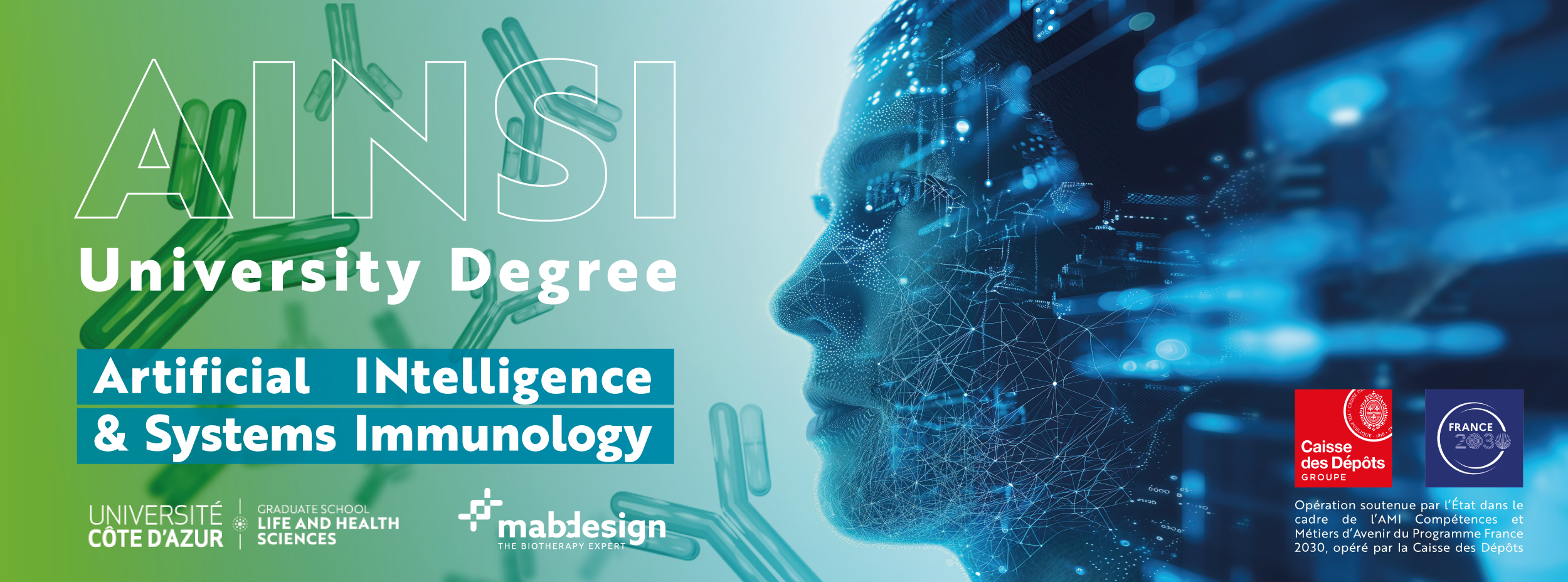
University Degree in Artificial INtelligence and Systems Immunology (AINSI)
- Science and Technology
- Medicine and Health
Résumé
To understand the AI methods applied to computational immunology and their applications (epitope design, diagnostics, personalised immunotherapy), whilst gaining proficiency in the bioinformatics tools and databases used for data analysis Read moreObjectifs
Details
Develop the skills needed for the future of medicine
Learn how to use bioinformatics tools, omics databases and AI approaches dedicated to computational immunology. Develop a unique skill set at the intersection of biology, data science and innovation in healthcare.
Accéder aux sections de la fiche
Introduction
Artificial intelligence (AI) has become essential in immunology, enabling, for example, the prediction of antigens and neoantigens, the spatial and temporal dynamics of immune cells, and improvements in immunotherapeutic engineering.
To meet this need, the University Diploma in Artificial Intelligence and Systems Immunology (DU AINSI) offers a course, delivered entirely in English, spread over 10 days in two modules combining theoretical lectures and practical workshops, totalling 70 hours.
Through an exploration of AI tools and their applications in immunology, the programme aims to provide an understanding of AI methods applied to computational immunology (epitope design, immunological diagnostics, immunotoxicology and personalised immunotherapy approaches) and to equip participants with proficiency in simple bioinformatics tools and the use of databases for omics analyses in computational immunology.
Enrolment limited to 16 seats:
-
10 participants from the private sector
-
6 participants from the public sector (researchers and PhD students)
Objectives
Specific objectives of the programme:
- To detect immunological biomarkers and improve diagnosis, image analysis and flow cytometry through the application of AI
- To model molecular interactions, personalise immunotherapy strategies and stratify patients (immuno-oncology and autoimmunity) through the use of integrated AI techniques
- Predict and analyse the immunotoxic risks of drugs, vaccines and innovative therapies; identify transcriptomic signatures of immunotoxicity; and predict interactions between drugs and the immune system through the expert application of AI
- Predict and select epitopes in vaccinology and immunotherapy, optimise immunogenicity and reduce immune evasion by pathogens and cells using AI principles
- Master the analysis of large-scale immunological data to model the dynamics of the immune system and develop digital immune maps that predict the progression of inflammatory and infectious diseases
Places
Conference room at the St Paul Hotel, in Nice (to be confirmed):
29 Bd Franck Pilatte, 06300 Nice
Person in charge of the academic program
-
Mme Claudine BLIN
Director of the Laboratory of Molecular Physiomedicine (LP2M).
Head of the Osteoimmunology, Niche Cells and Inflammation team..
-
M. Phillipe BLANCOU
Professor IPMC-INSERM
Head of the ‘Immunity Regulation by the Nervous System’ Team
Partnership
Research center
Institutions
|
|
| Rectorat d'Aix-Marseille ou de Nice | |
| Région Provence Alpes-Côte d'Azur | |
| Université de Toulon | |
| Aix-Marseille Université | |
Admission
Prerequisite
Target audience
- Scientific project managers
- Researchers
- Lecturers and researchers
- Clinicians
- PhD students
- Design engineers
- Research engineers
Application
Conditions of applications
Effectif
Please note : enrolment is limited to 16 seats
- 10 participants from the private sector- 6 participants from the public sector
How and when to register
Applications must be submitted from 15 September 2026 via the Université Côte d’Azur’ eCandidat platform.
If you encounter any difficulties with your registration, please consult the eCandidat user guide
egistration/application deadline: 29/11/2026
f you have any specific questions regarding your registration, please do not hesitate to contact: :
- For all enquiries: Clara.Esnault@mabdesign.fr Tel : +33 (0)4 78 02 39 93
- For specific enquiries from research candidates or PhD students: Jacqueline.TORRE@univ-cotedazur.fr
- For enquiries regarding continuing professional development: Marilyn.POLLET@univ-cotedazur.fr
Program
Content of the academic programm
- Module 1 – Introduction to Artificial Intelligence
-
- Training by EFELIA
- Theory and practice
- Module 2 – AI and Immunodiagnostics
-
- detection of immunological biomarkers (e.g., cytokines, autoantibodies, TCR/BCR sequencing, plasma proteins)
- combining genetic and clinical and environmental data for health diagnostics and predictive modeling
- diagnosis of autoimmune, infectious, and cancer-related diseases through deep learning
- analysis of imaging and cytometry data
- prediction of graft survival and the effectiveness of immunosuppressive therapies
- Module 3 – AI and Personalized Immunotherapy
-
- model molecular interactions
- personalize immunotherapy strategies and anticipate responses to immune checkpoint inhibitors using AI
- understand host-tumor interaction analyses through deep learning to optimize CAR-T therapies and anticancer vaccines
- stratify patients using machine learning
- predict graft survival and the effectiveness of immunosuppressive therapies
- Module 4 – AI and Epitope Design
-
- predict and select epitopes in vaccinology and immunotherapy
- optimize immunogenicity and reduce immune evasion by pathogens and cells
- use machine learning algorithms to predict B- and T-cell epitopes based on MHC-I/MHC-II interactions
- leverage databases
- Module 5 – AI and Immunomics
-
- predict and analyze immunotoxic risks of drugs, vaccines, and innovative therapies (hypersensitivity, autoimmunity, cytokine storms)
- identify transcriptomic signatures of immunotoxicity
- predict immunotoxicity (deep learning and clustering models)
- predict interactions between drugs and the immune system
Educationnal team
Steering Commitee
| Name | Title | Insitute | |
| Philippe BLANCOU | Teacher-researcherr | |
Philippe.BLANCOU@univ-cotedazur.fr |
| Claudine BLIN | Researcher - Research director | |
|
| Mikita ARTOMOV | Teacher-researcher | BROAD Institute (USA) GWASP |
|
| Max Artyomov | Researcher - PhD | WUST/LP2M Jetbrains biolabs (Munich) |
|
| Oleg Shpynov | Researcher - PhD | WUST/LP2M Jetbrains biolabs (Munich) |
Teaching Team
Salvish GOOMANEE |
Junior fellow |
EFELIA |
goomanee.salvish@gmail.com |
Rhythm
Full time
- The first part of the training course will take place from Monday 25 to Friday 29 January 2027 at the St Paul Hotel, Nice
- The second part will be held in June 2027 (details to be confirmed, subject to the experts’ availability)
What's next ?
Level of education obtained after completion
Degree equivalent to 4 or 5 years' higher education (Bac +4 & Bac +5)Target skills
RNCP URL of content
Target activities / attested skills
The specific objectives of the University Diploma, corresponding to the learning outcomes set out in the
RNCP38672 BC07 Master’s in Life Sciences:
To analyse data from experiments in the field of life sciences
To set up and carry out a comprehensive biological data processing workflow by selecting and using appropriate mathematical, statistical and/or bioinformatics tools
To contribute to the analysis of research experiments conducted within a scientific laboratory by applying knowledge across the various fields of life sciences
Submission
Tuition
Standard fee for Continuing Professional Development:
- 6000€
- Eligible for funding via the Professional Training Account (CPF)
- Eligible for funding via an OPCO
- The price includes meals and accommodation at the St Paul Hotel, Nice (29 Boulevard Franck Pilatte, 06300 Nice)
Reduced fees:
- Public sector researchers: €1,400
- PhD students: €1,000
Information about the AINSI University Degree can also be found on the MabDesign website: