














Projets
- Projet MIRACLE
-
Description du projet:MIRACLE is a European project.
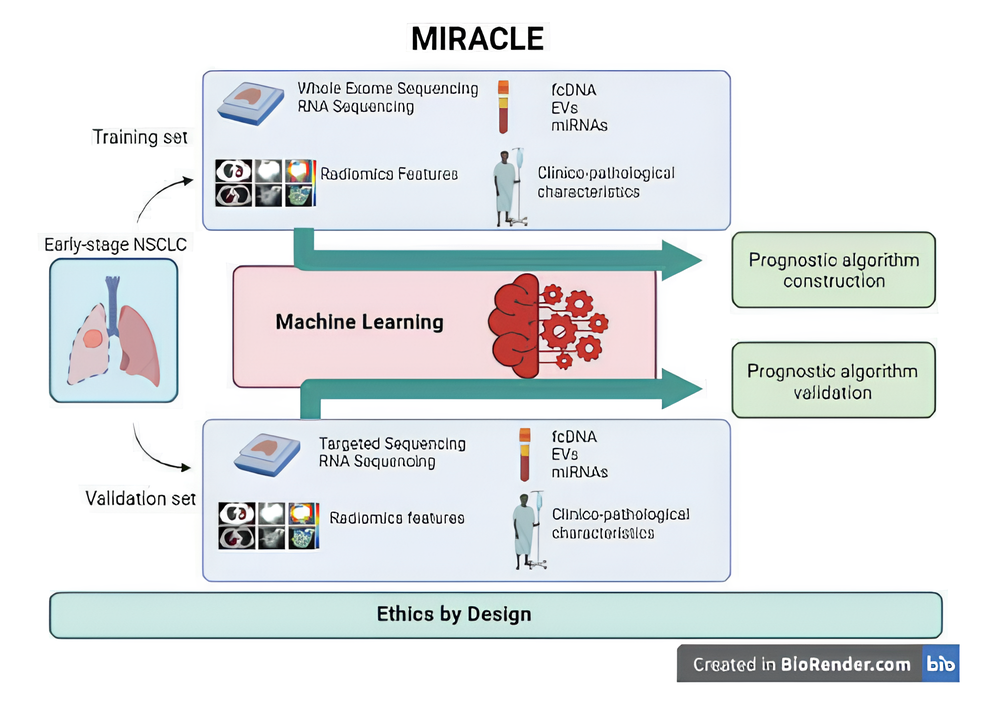
Early-stage non small cell lung cancer (ES-NSCLC) represents 20-30% of all NSCLC and is characterized by a high survival rate after surgery. However, there is variability in clinical outcomes among patients sharing the same disease stage, suggesting that other factors could determine the risk of relapse. Accurate and validated tools to stratify patients according to their risk of relapse are still lacking. Hypothesis: We hypothesize that multiple factors could influence the prognosis of resected ES-NSCLC patients. In particular, tumor tissue and microenvironment (TME) characteristics, liquid biopsy, radiomics features and clinical-pathological factors could all be involved. Aims: Primary: Development of a machine learning (ML) algorithm acting as a clinical decision support tool for disease free survival (DFS) prediction and patient stratification based on joint analysis of biological, clinical and radiologic features on a training cohort of resected ES-NSCLC. Secondary: Validation of the developed algorithm on an independent cohort.
Université Côte d'Azur coordinates axis 6 of the project, which focuses on ethical issues, under the leadership of Vanessa Nurock (CRHI).
More specifically, the goal is to embed in the project an "ethics by design" that operates at each stage of the project and addresses more than just its outcomes, by bringing together the ethics andpolicies of care to study various problems, focusing mainly on three questions:
• What is a doctor? The potential changes in the role of doctors with the integration of algorithms in the practice of medicine
• What is responsibility? The evolution of responsibility with these new medical practices and especially issues related to data (medical and algorithmic)
• What is a patient? The opportunities to further integrate patients and organizations into this research project from the very beginning.
Projet MIRACLE
Coordinatrice du projet: Paola Ulivi, IRST-IRCCS, Italie
Partenaires:
Felip Enriqueta, Fundacio Hospital Universitari Vall d’Hebron (HUVH) – Institut de Recerca (VHIR)/Fundacio Privada Institut d’Investigacio Oncologica de Vall d’Hebron (VHIO), Espagne
Mazieres Julien, Centre Hospitalier Universitaire Toulouse, France
Nurock Vanessa, Université de Côte d’azur (CRHI, Chaire UNESCO EVA), France
Rahm Erhard, University of Leipzig, Allemagne
Référence du projet: ERP-2021-23680708 - ERP-2021-ERAPERMED2021-MIRACLE
- Projet CulturIA
-
A propos du projet : CulturIA
- Débat d’idées 2024-2025: L’intelligence artificielle et ses effets sur la citoyenneté, Démocratie numérique, Désinformation, Education et Enseignement, Ethique.
-
A propos du projet : L’intelligence artificielle et ses effets sur la citoyenneté
- Projet ENDOTRAIN
-
L'endocrinologie numérique révolutionne les soins de santé en intégrant technologies, données et traitements personnalisés. Elle permet ainsi des soins plus précis, efficaces et accessibles, remettant en question les modèles médicaux traditionnels. Pour hisser l'endocrinologie numérique à un niveau supérieur de connaissances et de valeur translationnelle, une approche intégrative est nécessaire : il faut passer du modèle conventionnel reposant sur de multiples experts de disciplines différentes à un modèle où divers thèmes convergent au sein d'un seul expert.
Dans ce domaine en pleine évolution, les experts interdisciplinaires sont mieux à même de communiquer entre des disciplines telles que la médecine clinique, les sciences des données (y compris l'apprentissage automatique et l'intelligence artificielle), les mathématiques, l'ingénierie, la biochimie, la biotechnologie, l'éthique et le droit, tout en veillant à ce que les résultats de la recherche répondent aux besoins de la société.
EndoTrain a été créé pour répondre à la demande d'experts interdisciplinaires capables de faire progresser la recherche et les applications cliniques en endocrinologie numérique.
- Poste de doctorat
-
Rejoignez l’Université Côte d’Azur au sein du réseau européen MSCA ENDOTRAIN pour travailler sur les enjeux éthiques des jumeaux numériques en santé. Encadrement par la professeure Vanessa Nurock, environnement international, mobilité, formation interdisciplinaire et rémunération attractive.
Candidature avant le 31 juillet 2026.
Plus de détails dans le PDF ci-contre :