














Projects
- MIRACLE
-
Scientific summary of the projectMIRACLE is a European project.
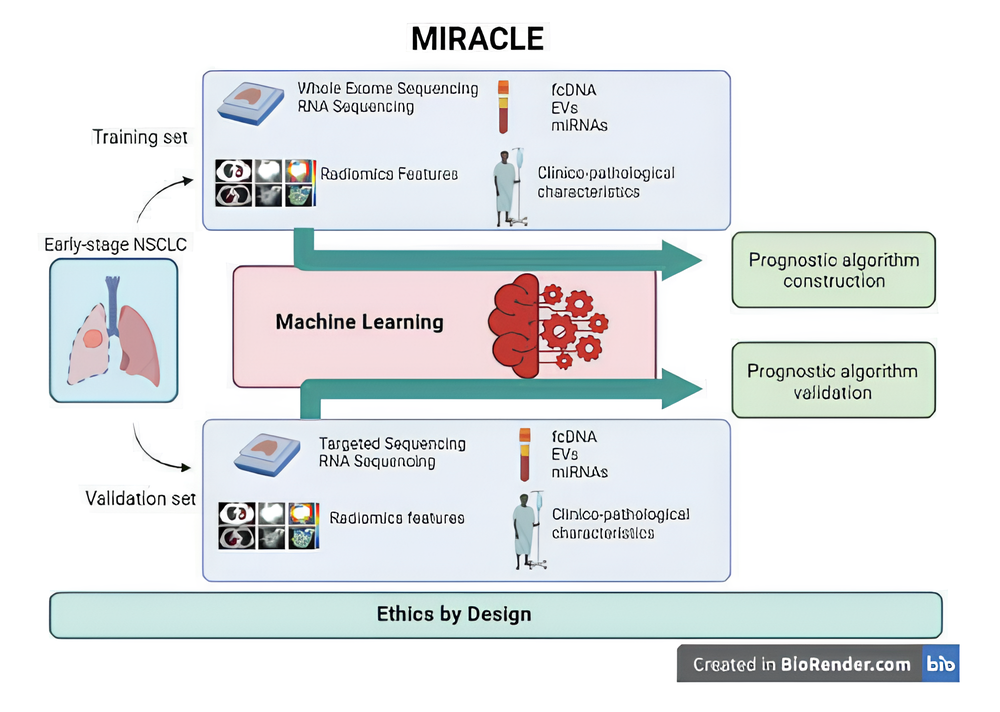
Early-stage non small cell lung cancer (ES-NSCLC) represents 20-30% of all NSCLC and is characterized by a high survival rate after surgery. However, there is variability in clinical outcomes among patients sharing the same disease stage, suggesting that other factors could determine the risk of relapse. Accurate and validated tools to stratify patients according to their risk of relapse are still lacking. Hypothesis: We hypothesize that multiple factors could influence the prognosis of resected ES-NSCLC patients. In particular, tumor tissue and microenvironment (TME) characteristics, liquid biopsy, radiomics features and clinical-pathological factors could all be involved. Aims: Primary: Development of a machine learning (ML) algorithm acting as a clinical decision support tool for disease free survival (DFS) prediction and patient stratification based on joint analysis of biological, clinical and radiologic features on a training cohort of resected ES-NSCLC. Secondary: Validation of the developed algorithm on an independent cohort.
Université Côte d'Azur coordinates axis 6 of the project, which focuses on ethical issues, under the leadership of Vanessa Nurock (CRHI).
More specifically, the goal is to embed in the project an "ethics by design" that operates at each stage of the project and addresses more than just its outcomes, by bringing together the ethics andpolicies of care to study various problems, focusing mainly on three questions:
• What is a doctor? The potential changes in the role of doctors with the integration of algorithms in the practice of medicine
• What is responsibility? The evolution of responsibility with these new medical practices and especially issues related to data (medical and algorithmic)
• What is a patient? The opportunities to further integrate patients and organizations into this research project from the very beginning.
Projet MIRACLE
Coordinator:
Paola Ulivi, IRST-IRCCS, Italy
Partners:
Felip Enriqueta, Fundacio Hospital Universitari Vall d’Hebron (HUVH) – Institut de Recerca (VHIR)/ Fundacio Privada Institut d’Investigacio Oncologica de Vall d’Hebron (VHIO), Spain
Mazieres Julien, Centre Hospitalier Universitaire Toulouse, FranceNurock Vanessa, Université de Côte d’azur (CRHI), France
Rahm Erhard, University of Leipzig, GermanyProject reference : ERP-2021-23680708 - ERP-2021-ERAPERMED2021-MIRACLE.i
- CULTURIA
-
Learn more about the CulturIA Project - ENDOTRAIN Project
-
Digital endocrinology is revolutionizing healthcare by integrating technology, data, and personalized treatments. This enables more precise, effective, and accessible care, challenging traditional medical models. To elevate digital endocrinology to a higher level of knowledge and translational value, an integrative approach is needed: a shift from the conventional model relying on multiple experts from different disciplines to one where diverse themes converge within a single expert.
In this rapidly evolving field, interdisciplinary experts are best positioned to communicate across disciplines such as clinical medicine, data science (including machine learning and artificial intelligence), mathematics, engineering, biochemistry, biotechnology, ethics, and law, while ensuring that research outcomes address societal needs.
EndoTrain was created to meet the demand for interdisciplinary experts capable of advancing research and clinical applications in digital endocrinology.
- PhD Opportunity
-
Join Université Côte d’Azur and the Horizon Europe MSCA network ENDOTRAIN to explore the ethical challenges of biomedical digital twins. Supervision by Prof. Vanessa Nurock. Competitive salary, international mobility, interdisciplinary training.
Apply by 31 July 2026.
More details in PDF bellow :